From a ₹50,000 startup to a reported ₹200 crore annual network GMV, Zorko is challenging traditional food franchise economics through a chef-less kitchen and supply-led business model.
From a Small Beginning to a Growing Food Franchise Network
Building a successful food franchise brand requires more than a popular menu or an attractive restaurant interior. It requires a business model that can be replicated, standardised and sustained across multiple locations.
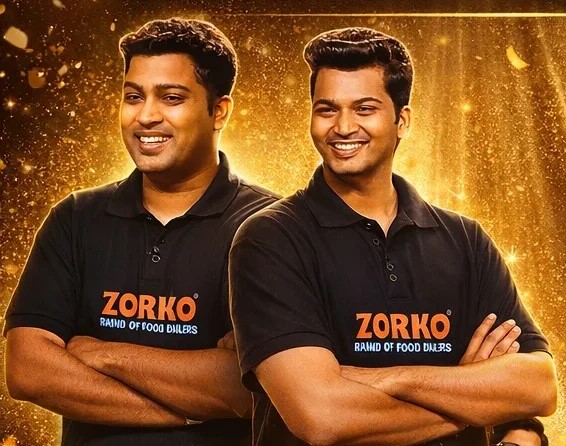
Zorko, founded by brothers Anand Nahar and Amrit Nahar in Surat, Gujarat, is an interesting example of this approach.
What started as a small entrepreneurial venture during the COVID-19 pandemic has evolved into a vegetarian quick-service restaurant (QSR) brand with a reported network of more than 550 outlets across 275 cities and 25 states in India.
Its growth story is particularly interesting because of its unconventional franchise economics, simplified kitchen operations and supply-chain-driven revenue model.
The Entrepreneurial Beginning: An Investment of Just ₹50,000
The founders’ entrepreneurial journey did not begin with a restaurant.
During the COVID-19 pandemic in 2020, Anand and Amrit identified an opportunity in the immunity and wellness segment. They launched herbal immunity booster sachets containing 14 herbs, priced at ₹30.
With an initial investment of approximately ₹50,000, they began selling through WhatsApp groups and Facebook communities.
According to founder interviews, the business generated more than ₹60 lakh in revenue between 2020 and 2021.
However, changing market conditions encouraged the brothers to explore another business opportunity.
Their attention shifted towards the food and beverage industry.
In 2021, they acquired a small food outlet in Surat for approximately ₹4.5 lakh and began building what would eventually become Zorko.
Identifying an Opportunity in Affordable Vegetarian Fast Food
The founders identified an opportunity in the affordable vegetarian fast-food market.
Consumers were increasingly exploring products such as burgers, pizzas, pasta, momos, fries and beverages. However, these offerings were often spread across different food outlets.
Zorko aimed to bring multiple food categories under one roof while maintaining affordable pricing.
Its initial positioning focused on three factors:
- Affordable food.
- Multiple vegetarian fast-food options.
- A comfortable dining experience.
During its early operations, the brand introduced selected products at entry-level prices, including burgers starting at ₹20 and pizzas and pasta at ₹50.
This value-driven positioning helped the brand attract customers looking for affordable eating-out options.
The Innovation Behind Zorko: A Chef-Less Kitchen Model
One of Zorko’s most interesting business innovations is its chef-less kitchen concept.
Traditional restaurant businesses often depend on experienced chefs for food preparation. This creates operational challenges when a brand tries to expand across several cities.
Recruiting skilled chefs, maintaining consistency, managing manpower expenses and standardising recipes can become difficult for a growing franchise network.
Zorko addressed this challenge through standardised recipes, proprietary premixes, sauces and simplified preparation processes.
The objective was to enable trained kitchen staff to prepare menu items without depending on specialised chefs.
This approach offers several operational advantages:
- Simplified kitchen operations.
- Reduced dependence on specialised manpower.
- Standardised food preparation.
- Easier staff training.
- Greater operational consistency.
- Better potential for multi-location expansion.
For a franchise business, the ability to replicate operations is a significant advantage.
Zorko’s approach demonstrates how process standardisation can become an important part of franchise scalability.
The No-Royalty Franchise Model: A Different Approach to Franchise Economics
One of the most distinctive aspects of Zorko’s business model is its no-conventional-royalty approach.
In a traditional food franchise arrangement, franchisees generally pay an initial franchise fee and recurring royalties calculated as a percentage of monthly sales.
Zorko has adopted a different revenue strategy.
According to founder Anand Nahar’s interview with Startup Pedia, the company’s revenue mix is approximately:
- 25% from franchise fees.
- 75% from raw-material and proprietary ingredient supplies.
These supplies include sauces, syrups, premixes and masalas.
Instead of depending primarily on monthly royalty collections, the company generates recurring business through its supply-chain ecosystem.
This model creates an interesting relationship between the franchisor and franchisee.
As franchise outlets continue operating and generating customer demand, they require regular supplies from the central business.
Consequently, the franchisor’s recurring revenue opportunity is linked to the operational activity of its franchise network.
However, the model also requires competitive supply pricing, efficient logistics and healthy franchisee-level profitability.
The absence of conventional royalties does not automatically mean that the franchise is low-cost or highly profitable. The complete investment and operating economics must always be evaluated.
Building a Supply Chain to Support Expansion
Expanding a food brand across India involves more than signing franchise agreements.
Every outlet needs consistent ingredients, standardised products and dependable delivery systems.
During its early expansion, Zorko reportedly faced challenges in transporting raw materials and premixes to distant locations.
The founders explored alternative logistics arrangements, including using existing bus and truck transportation routes, to reduce distribution costs.
This operational learning highlights an important lesson for emerging franchise businesses.
A brand may have an attractive product and a promising franchise opportunity, but without an effective supply-chain network, maintaining quality and consistency across locations becomes difficult.
For Zorko, supply-chain development became an important part of its expansion strategy.
Shark Tank India: National Visibility for the Brand
Zorko gained wider attention after appearing on Shark Tank India Season 3 in 2024.
The founders sought ₹1.5 crore in exchange for 1% equity.
Although discussions took place with investor Aman Gupta, the negotiations did not result in an investment deal.
Nevertheless, the television appearance brought the brand national visibility.
The experience demonstrates that startup exposure can create business value beyond fundraising.
For an emerging franchise brand, media visibility can improve brand awareness, generate customer interest and attract potential franchise enquiries.
What Makes Zorko’s Franchise Model Interesting?
Zorko’s journey provides several useful lessons for aspiring franchise entrepreneurs and food business owners.
1. Standardisation creates scalability
A business that depends entirely on individual talent can be difficult to replicate. Standardised recipes and processes help simplify operations.
2. Affordable positioning can create wider market opportunities
Value-oriented food concepts can attract customers in markets beyond major metropolitan cities.
3. Supply-chain infrastructure is a competitive advantage
Centralised procurement and proprietary ingredients can help maintain consistency and create recurring revenue opportunities.
4. Franchise economics deserve more attention
A franchise model should create sustainable returns for both the franchisor and franchisee. The absence of sales-based royalties can be an interesting differentiator, but supply pricing and operating costs must be evaluated.
5. Diversification can create new growth opportunities
Building multiple food brands can help a company explore different consumer segments while potentially leveraging shared operational infrastructure.
Can Other Food Brands Replicate the Zorko Model?
Zorko’s business model raises an interesting question for the Indian food franchise industry.
Can a food brand expand across hundreds of outlets without depending on conventional royalty income?
The answer is yes, provided the franchisor develops alternative revenue streams that create genuine value for franchise partners.
These may include:
- Centralised ingredient procurement.
- Proprietary food products.
- Technology subscriptions.
- Equipment leasing.
- Packaging and distribution.
- Brand licensing.
- Operational support services.
However, a sustainable franchise model must also ensure that franchise partners have sufficient operating margins and access to reliable support.
A franchise network cannot survive through expansion fees alone. It needs a strong underlying business model.
The Bigger Lesson for India’s Franchise Industry
Zorko’s entrepreneurial journey is an interesting case study in how business model innovation can influence franchise expansion.
From an initial ₹50,000 investment in an immunity booster venture to a reported 550+ outlet food franchise network, Anand and Amrit Nahar have demonstrated the importance of experimentation, operational learning and business model adaptation.
Its chef-less kitchen concept and supply-led revenue structure offer an alternative perspective on traditional food franchise economics.
For emerging food entrepreneurs, the lesson is clear: building a franchise-ready business requires more than developing a popular food product. It requires creating a system that can be replicated, managed and sustained across locations.
The future of food franchising may not depend only on how many outlets a brand opens, but on how effectively its business model creates value for every franchise partner.